Collaborative Delivery
Building water and wastewater infrastructure as one team, from the first conversation to final commissioning.
About PKG Collaborative
The recent influx of collaborative delivery in our region has elucidated the need for professionals that specialize in finding alternative solutions for meeting project demands. PKG Collaborative, Inc. (PKG) was created to merge our extensive construction experience with the creative insight necessary for collaborative partnerships. For more than 30 years, PKG has built the water and wastewater infrastructure that keeps our communities running. Collaborative delivery is how we do our best work: bringing owners, engineers, and our construction team together at the earliest stages of a project so that budget, schedule, and design decisions are made side by side, not handed off. Whether the vehicle is Construction Manager at Risk (CMAR) or Design-Build, the goal is the same — one team, one set of priorities, and a facility that meets the needs of the communities we serve.
What Collaborative Delivery Means for Your Project
Traditional low-bid construction asks an owner to finalize a design before a contractor ever weighs in on cost, schedule, or constructability. Collaborative delivery methods — CMAR and Design-Build — flip that sequence. PKG joins the project team during preconstruction, while design is still evolving, so constructability input, real-time cost feedback, and phasing strategy shape the plans instead of reacting to them.
Under a CMAR agreement, PKG acts as the owner’s construction advisor through design and then converts to the general contractor at a negotiated Guaranteed Maximum Price (GMP). Design-Build consolidates design and construction under a single point of responsibility, streamlining communication and accelerating schedule. In both models, the owner and engineer keep a seat at the table throughout — collaborative delivery is a relationship, not just a contract structure.
For owners and engineers evaluating a phased plant expansion, an active-facility renovation, or any project where operations cannot stop for construction, that early involvement is what protects budget certainty, keeps schedules realistic, and reduces the surprises that come from designing in a vacuum.
Collaborative Delivery in Action
PKG’s CMAR portfolio spans some of the region’s most complex active-facility expansions. Two representative projects:
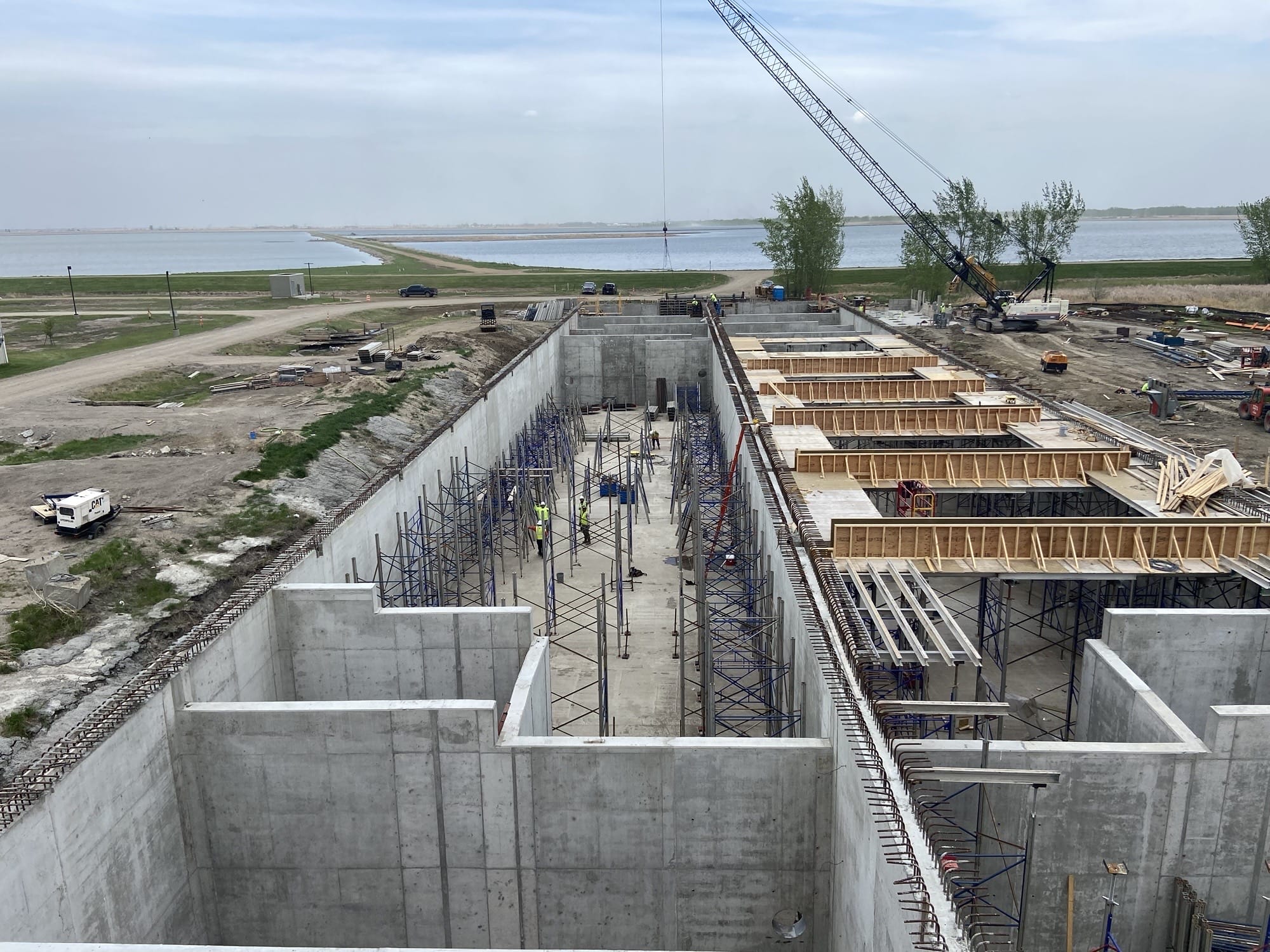
Grand Forks Wastewater Treatment Facility, Phase I & II Improvements
| Owner | City of Grand Forks, ND |
| Delivery Method | CMAR |
| Contract Value | $90,500,000 |
| PKG Self-Performed | 78% |
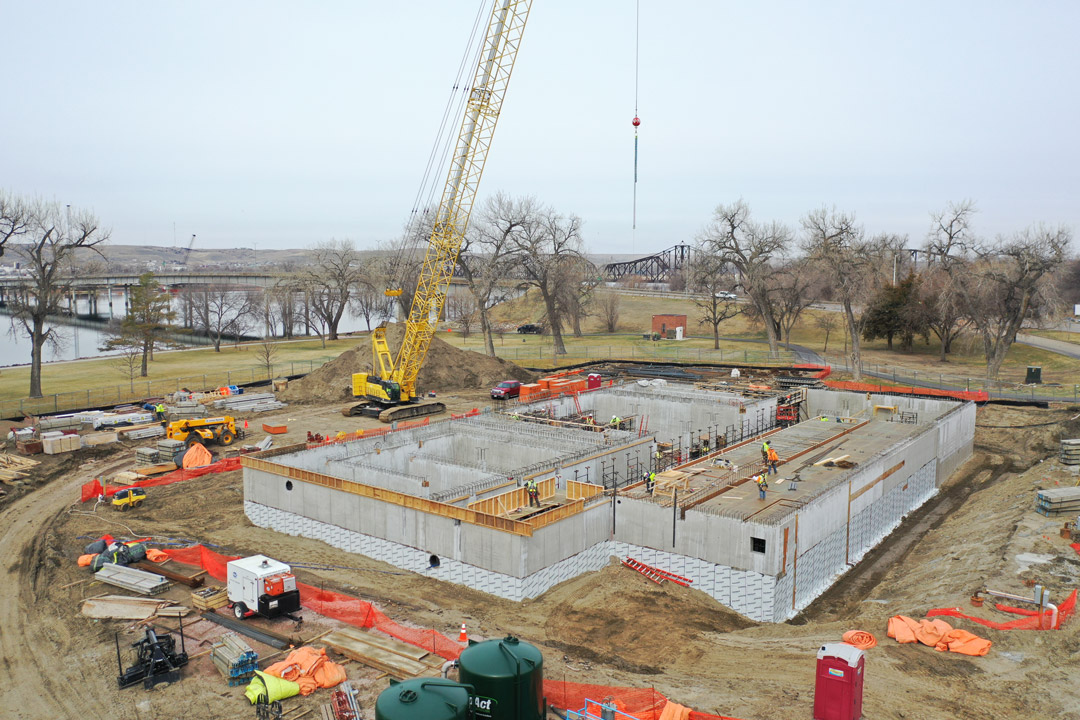
PKG’s largest ongoing CMAR project involves major process upgrades executed alongside an operating treatment facility with complex, interconnected flow profiles. Careful sequencing has kept the plant performing throughout construction.
An early work authorization for deep foundations — delivered through a PKG-delegated helical pier design in place of the originally specified driven H-piles — saved the project $4 million and three months of schedule during one of the coldest construction seasons in the country. The facility generator and membrane bioreactor equipment were pre-procured to protect the budget from market volatility and keep procurement aligned with design. PKG also proposed and built a new permanent access road to relieve daily conflicts between plant deliveries and construction traffic; the City now plans to adopt it as the facility’s primary access after project completion.
Fargo Effluent Reuse Facility
| Owner | Cass Rural Water District |
| Delivery Method | CMAR |
| Contract Value | $90,500,000$20,400,000 |
| PKG Self-Performed | 70% |
To protect the project schedule, PKG pre-procured the facility’s UF/RO (ultrafiltration/reverse osmosis) equipment package at 60% design — moving a major long-lead system out of the critical path well ahead of the traditional procurement point.
That early move only worked because PKG’s team was already operating as one unit with the design engineer. PKG worked directly with the design team to expedite submittal review, scheduling a joint workshop where both teams sat down together and turned around a 1,500-page submittal package in a single eight-hour workday — the kind of direct, hands-on coordination that is only possible when the owner, engineer, and contractor are working from the same table instead of passing documents back and forth.
How PKG Approaches Every Collaborative Project
PKG’s approach to collaborative delivery is built on the CMAR work we’ve done across North Dakota, South Dakota, and now our expanding Kentucky and Tennessee markets — including some of the first municipal water and wastewater CMAR projects delivered in our home region. That experience has shaped a consistent set of practices that PKG brings to every collaborative delivery project, regardless of size or location.
Open-Book Transparency
Every cost estimate is backed by detailed sheets showing quantities and pricing by bid package, so owners and engineers can see exactly what drives the number — not just the number itself. General conditions are negotiated and fixed at GMP rather than buried in a lump sum. Unused contingency has been returned to the owner as savings on all but one of PKG's CMAR projects to date.
Delegated Design and Pre-Procurement
PKG's self-perform crews and in-house engineering give the team room to solve problems as they arise, rather than waiting on outside consultants to weigh in. When site conditions call for an alternate foundation approach, a revised sequencing plan, or a faster path through a design question, PKG's own engineering staff can develop and manage a delegated design solution through to stamped construction drawings. That same self-perform capability supports a pre-procurement strategy for long-lead equipment and materials, protecting project budgets from market volatility and keeping procurement moving in step with design.
Proactive Risk Management
Risks are identified collaboratively with the full project team and logged in a shared risk register, each one evaluated for impact and likelihood and assigned a dollar value that feeds directly into the cost model. That register is revisited at every design milestone, giving owners a clear, continuously updated picture of what could affect budget or schedule — before it does.
Operations-First Coordination
Most of PKG's collaborative delivery work happens inside active treatment facilities that cannot go offline. That means early utility potholing to confirm as-built conditions, monthly look-ahead schedules, weekly production meetings, and a standing seat for plant operations staff at project meetings — so shutdowns, tie-ins, and commissioning are planned around how the facility actually runs, not just how the drawings say it should.
What Our Partners Say
“From cost estimating to project management to construction, the PKG team has demonstrated exceptional attention to detail, disciplined budget management, and a commitment to running a safe and productive job site.”
— Melanie Parvey, Public Works Director, City of Grand Forks, ND
“I have been extremely fortunate to work with the PKG Contracting, Inc. team on some great projects over my 30+ years with AE2S. In our industry, large-scale water and wastewater construction projects require a general contractor that can provide seamless coordination between all of the different trades with little to no interruption of work. The PKG team is staffed with individuals that help keep their projects running smoothly from start to finish, on task, on budget, and on time. PKG has successfully delivered projects through both traditional design-bid-build (DBB) and construction management at risk (CMAR) delivery methods.”
— Brian Bergantine, Project Quality Director, AE2S
Let's Build the Next Project Together
If your utility or district is evaluating CMAR, Design-Build, or another collaborative delivery approach for an upcoming water or wastewater project, PKG’s preconstruction team is ready to talk through what that partnership could look like — from early budgeting through final commissioning.
For questions about collaborative delivery, reach out directly:
Madison Alberts, Associate DBIA
Alternative Delivery Manager, PKG Collaborative, Inc.